Custom Software vs. Off-the-Shelf Solutions: Which Is Right?
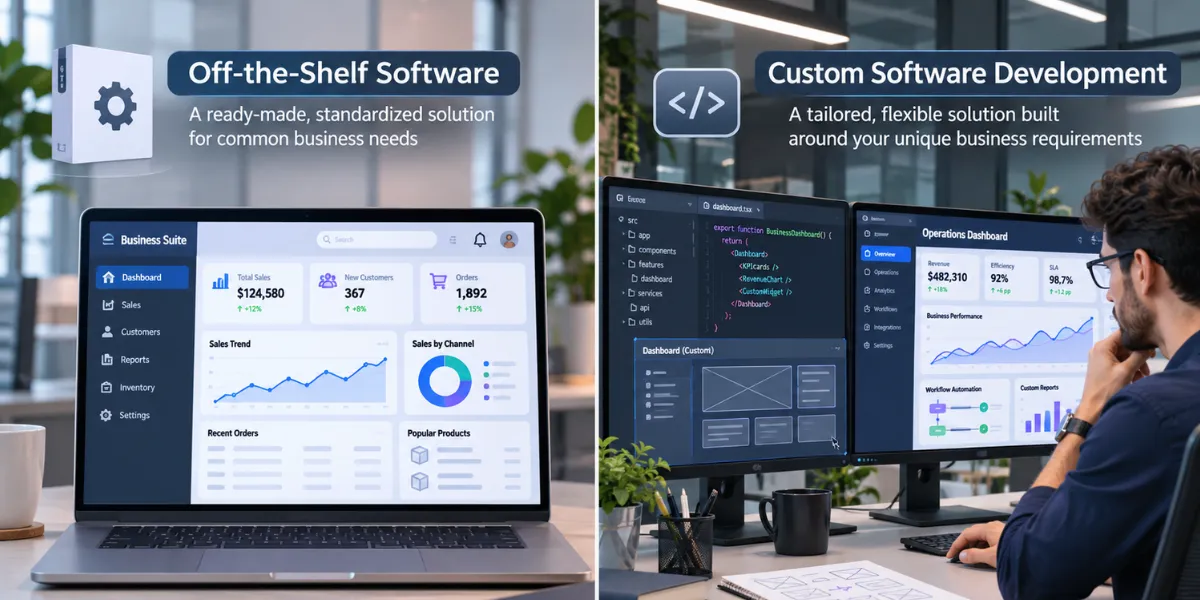
You have outgrown your spreadsheets. The manual workarounds that held things together at ten employees are now slowing down a team of fifty. You need software, but the next decision will shape how your business runs for years: do you buy something off the shelf, or do you build something from scratch? At its core, custom software vs. off-the-shelf is a decision about how you want your business to run.
Pick wrong, and you will spend months forcing your team into a tool that was never designed for how you actually work. Pick right, and you unlock speed, clarity, and a system that grows with you.
At Sky Vista Consulting, we have helped businesses on both sides of this decision. Here is what we have learned about when each path makes sense and how to choose between them.
What Is Off-the-Shelf Software?
Off-the-shelf software is a prebuilt product designed for a broad market. Think QuickBooks for accounting, Salesforce for CRM, or Shopify for e-commerce. The vendor builds it once and sells licenses to thousands of businesses.
You install it (or log in), adjust some settings, and your team is working inside it the same week. That speed is real, and for standard business functions it is often all you need. But here is what most buyers do not think about upfront: the product was designed for the average user across every industry. If your operations differ from that average, the gaps show up fast.
What Is Custom Software?
Custom software is built specifically for your organization's workflows. Instead of reshaping your team around a product's limitations, custom-developed software reshapes the tool around the way you already operate.
This can be a web app, a mobile tool, an internal dashboard, or an integration layer connecting platforms your team already uses. The scope ranges from lightweight automation to full enterprise systems.
According to Grand View Research, the global custom software development market was worth $45.4 billion in 2025 and is forecast to grow at an 18.8% CAGR through 2033. That is not a passing number. It reflects a widening gap between what off-the-shelf software offers and what growing businesses actually need.
Where Off-the-Shelf Software Still Wins
Before you assume custom is always better, here is what packaged products genuinely do well.
-
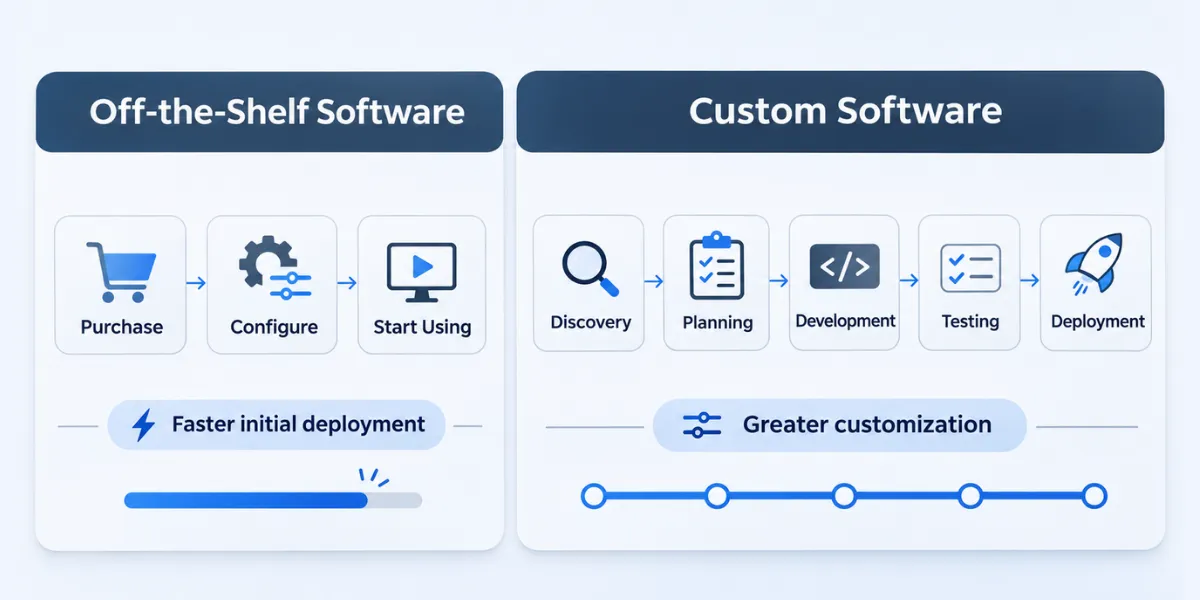
Faster deployment. Most off-the-shelf technology can be live in days. When you need a tool before the quarter closes, that speed matters.
-
Lower upfront cost. A subscription is cheaper to start than funding a build. For bootstrapped teams, the barrier to entry is lower.
-
Vendor-managed updates. Security patches and feature releases are the vendor's responsibility, not yours.
-
Built-in community. Popular platforms ship with documentation, forums, and integrations that flatten the learning curve.
For standard functions like email, basic accounting, or HR, the advantages of off-the-shelf software are hard to beat. The trouble starts when your needs are not standard.
Where Off-the-Shelf Software Falls Short
Convenience has a cost, and it usually shows up six months after you sign the contract.
-
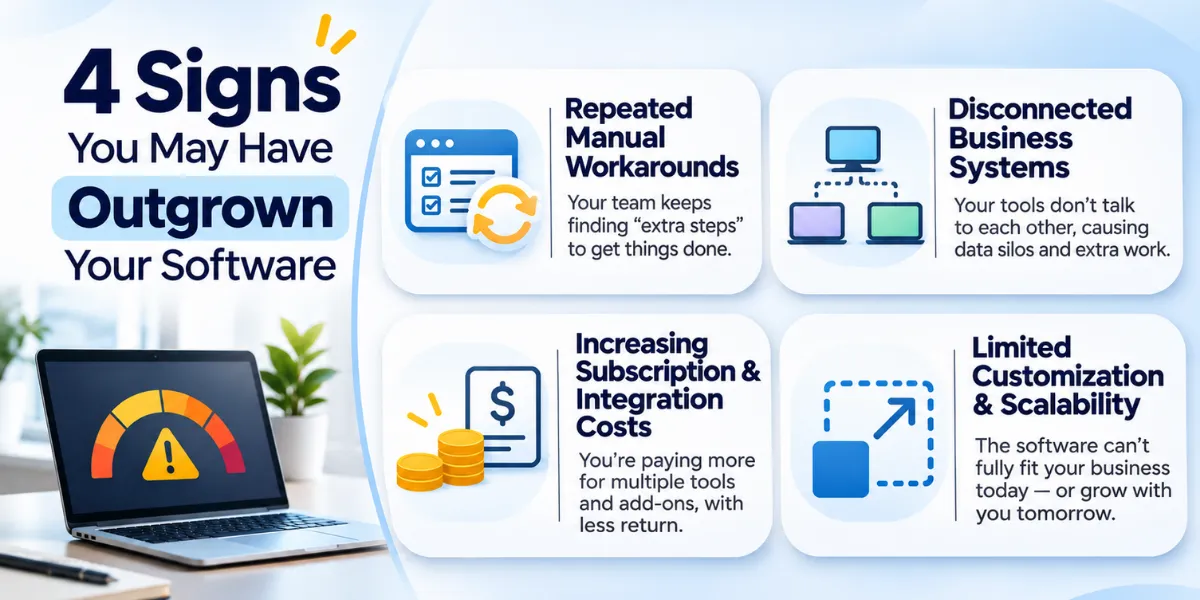
Limited customization. The product was built for the average user. If your workflow deviates from that average, you end up building manual workarounds that breed errors.
-
Vendor dependency. Price hikes, discontinued features, and forced updates are outside your control. One vendor pivot can break a process your team depends on.
-
Integration headaches. Connecting off-the-shelf software to your existing systems often requires middleware, manual entry, or expensive paid connectors. Every tool you add is one more connection that can break.
-
Scaling costs. Per-seat pricing scales with headcount, not value. A $50/user/month subscription for 30 people is $54,000 over three years before extras.
-
Data lock-in. Moving your data out of a proprietary platform is not always straightforward. Some vendors make it deliberately difficult.
These disadvantages of off-the-shelf software are invisible at purchase. They surface once the product is embedded in daily operations and switching costs are high.
What Custom Developed Software Gets Right
When you evaluate custom software vs. off-the-shelf options honestly, the advantages of building become clear if any of the following describe your business.
-
Your process is the product. When your competitive edge comes from the way you deliver, fulfill, or manage relationships, generic tools dilute that advantage. A development off-the-shelf solution cannot replicate what makes your operation distinct.
-
You have outgrown your stack. Bolting plugins and workarounds onto software that was not built for your scale creates technical debt. At some point, maintaining those workarounds costs more than building the right tool.
-
Your systems need to talk to each other. When your CRM, invoicing platform, and marketing tools need to share data in real time, custom software becomes the connective layer that eliminates manual transfers.
-
You need full ownership. With custom-developed software, you own the code, the data, and the product roadmap. No vendor can raise your price or sunset a feature you depend on.
Related Article: AI Automation for Small Businesses: 7 Quick Wins
Custom Software vs. Off-the-Shelf: How to Decide
The custom software vs. off-the-shelf decision is not about which category is better. It is about which path matches your situation right now.
Here is a quick side-by-side look at how the two approaches stack up.
|
Factor |
Off-the-Shelf Software |
Custom Developed Software |
|
Time to deploy |
Days to weeks |
Weeks to months |
|
Upfront cost |
Low (subscription or license) |
Higher (development investment) |
|
Long-term cost |
Compounds with per-seat pricing |
Levels off after the initial build |
|
Customization |
Limited to the vendor’s feature set |
Built around your specific workflows |
|
Ownership |
Vendor owns the product and roadmap |
You own the code, data, and direction |
|
Maintenance |
Vendor-managed automatically |
Your team or a development partner |
|
Integration |
Requires middleware or paid connectors |
Designed to connect your existing stack |
|
Scalability |
Scales with pricing tiers |
Scales with your architecture |
With that context, run through these four questions.
-
How unique is your workflow? If your team works the way most companies in your industry do, off-the-shelf covers 80% of your needs. But if your process is what sets you apart, that missing 20% matters more than the first 80%.
-
What does a three-year cost really look like? A monthly subscription looks affordable until you multiply it by headcount and add integration fees. Custom builds cost more upfront but eliminate per-seat licensing that compounds every year.
-
How many systems need to share data? Every connection between off-the-shelf software products is a potential failure point. Five or more platforms sharing data is a strong signal that a unified custom layer would reduce complexity.
-
Do you have someone to own the project? Custom software needs a decision-maker on your side who can test features and set priorities. If you cannot assign that role, a development partner who manages the process end to end is the practical move.
Can You Combine Custom Software and Off-the-Shelf Solutions?
Most businesses do not need to go all in on one approach. The smartest answer to the off-the-shelf software vs. custom software question is usually a hybrid: use packaged products where they genuinely fit, and build custom where differentiation, integration, or control is the priority.
Here is what that looks like in practice. A mid-sized logistics company uses Salesforce for CRM, QuickBooks for accounting, and Shopify for order management. All three are off-the-shelf software and handle their core functions well. But the company's dispatch workflow, routing drivers based on delivery windows, vehicle capacity, and real-time conditions, does not fit any packaged product. So they build a custom dispatch layer that connects to all three platforms via APIs. The standard tools keep doing what they do best. The custom layer handles the logic no vendor anticipated.
That is how Sky Vista Consulting approaches software development. We start with your workflows, not with code. We identify where generic tools fall short, scope only what needs to be custom, and keep budgets and timelines grounded in reality.
If you are stacking workarounds on top of tools that were never designed for your operation, you are already paying for custom software. You are just paying in lost productivity instead of a focused build.
Loomy360™ is one example of this thinking in practice. An all-in-one SaaS business operations platform, it brings client management, project tracking, proposals, invoicing, bookings, and marketing automation into one place. Rather than building every supporting service from scratch, the platform integrates with established third-party services for payments and other operational needs. We designed and built its marketing website, developed a content strategy, and created a campaign system aligned with the product's positioning, giving Loomy360™ a consistent public presence that communicates the platform's capabilities.
Frequently Asked Questions
01. What is the main difference between custom and off-the-shelf software?
Custom software is built for your specific workflows and requirements. Off-the-shelf software is a prebuilt product sold to many businesses with a standardized feature set. When weighing off the shelf software vs custom software, the core difference is whether the tool adapts to your process or your process adapts to the tool.
02. Is custom software always more expensive?
Not over the long term. Custom has a higher upfront cost, but it eliminates recurring license fees and the cost of workarounds. Over three to five years, total cost of ownership can favor a custom build for growing teams.
03. How long does a custom software project take?
It depends on scope. A focused internal tool can ship in four to eight weeks. A full platform with multiple user roles and integrations may take three to six months. Clear requirements from the start keep timelines realistic.
04. Can I start with off-the-shelf and switch to custom later?
Yes, and many businesses do. The key is planning your exit strategy before you commit to a vendor. Make sure your data is portable so the transition is not more painful than necessary.
05. What types of businesses benefit most from custom software?
Businesses with unique workflows, strict compliance requirements, or complex integration needs see the strongest return. This includes healthcare, logistics, financial services, and any company where the process itself is the competitive edge.
06. What is the total cost of off-the-shelf vs. custom software?
Total cost of ownership includes licensing fees, integration costs, training, workarounds, and lost productivity over three to five years. Off-the-shelf software often looks cheaper upfront, but per-seat pricing, paid connectors, and forced upgrades compound fast. Custom software has a higher initial investment but no recurring license fees, which can make it the more cost-effective option at scale.
07. Who handles maintenance and updates for custom-developed software?
With off-the-shelf products, the vendor manages updates automatically. With custom-developed software, you can either hire an internal developer or partner with your development agency for ongoing maintenance. Most agencies offer support contracts that cover security patches, feature additions, and performance monitoring, so you do not need a full-time hire to keep the system running.